> For the complete documentation index, see [llms.txt](https://dbi-services.gitbook.io/omrun-help/llms.txt). Markdown versions of documentation pages are available by appending `.md` to page URLs; this page is available as [Markdown](https://dbi-services.gitbook.io/omrun-help/configuration/dashboard-configuration.md).
# Dashboard Configuration
### 
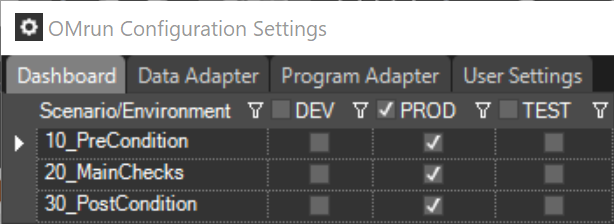
### Select scenarios to publish
All scenarios are listed against all environments in the upper grid to select and activate if they should be published. For each environment there is a tick / un-tick all box.
The matrix is generated from the business system and is automatically adjusted if scenarios or environments are added or removed.
If you rename an environment or a scenario you have to set the publish flag again.
OMrun dashboard configuration settings
***
### Set path to the dashboard location
The publish target is set via path to reach the correct OMdashboard database. It is possible to use environment variable within the path definition to direct data to different OMdashboard installation if using different environments.\
Default path: `C:\inetpub\wwwroot\OMdashboard\App_Data`\
Default link: `http://localhost/OMdashboard/`
OMrun dashboard path and link settings
***
### Set Object Mapping to OMdashboard
All the objects (Scenario, Component, Object, Parameter) can be mapped to the different levels on the OMdashboard. Initially the default mapping is set to:
* Level 1 = Scenario
* Level 2 = Component
* Level 3 = Object
If you press the button "Default" the default mapping is restored.
OMrun dashboard mapping settings
In case you want to see a different representation of your tests results on the OMdashboard you can select one of the pre-defined mappings for each level.
If any static text or an existing environment variable is entered directly into one of the level text boxes, it shows the static value or the content of the variable as a constant text / link on the OMdashboard.
To restore the default mapping press the button "Default".